Macros->calories math

My understanding is that a gram of fat is 9 calories, a gram of protein is 4, and a gram of carbs is also 4 calories. I found a post on this forum where a dietician confirmed this.
So why are Crono's totals different from this?
For example, Crono added up my dinner tonight and shows macros
4g of fat, 47g of carbs, 52g of protein and total calories of 468 kcal.
But 94 + 447 + 452 comes out to 432 calories.
Is this just a matter of accumulated round-off errors when it's adding individual foods and ingredients?
Looking over my diary, it seems like the Crono calorie total is always *more than the total from the actual macro arithmetic, which seems weird to me if it's a rounding error.
Over the day, it adds up!
I'm just wondering how it works and why it's showing contradictory totals, thanks
Answers
-
Food composition databases can use specific Atwater factors, which account for differences in the digestibility and energy yield of different foods. For example, Cronometer's forum support has given a beef tenderloin example with 3.87 kcal/g of carbohydrates, 4.27 kcal/g of protein, and 9.02 kcal/g of fat.
In your example, Difference = 36 kcal, or about 8.3% of your calculated total.
BTW, you should use a relative measure where your maintenance is adjusted per your intake.
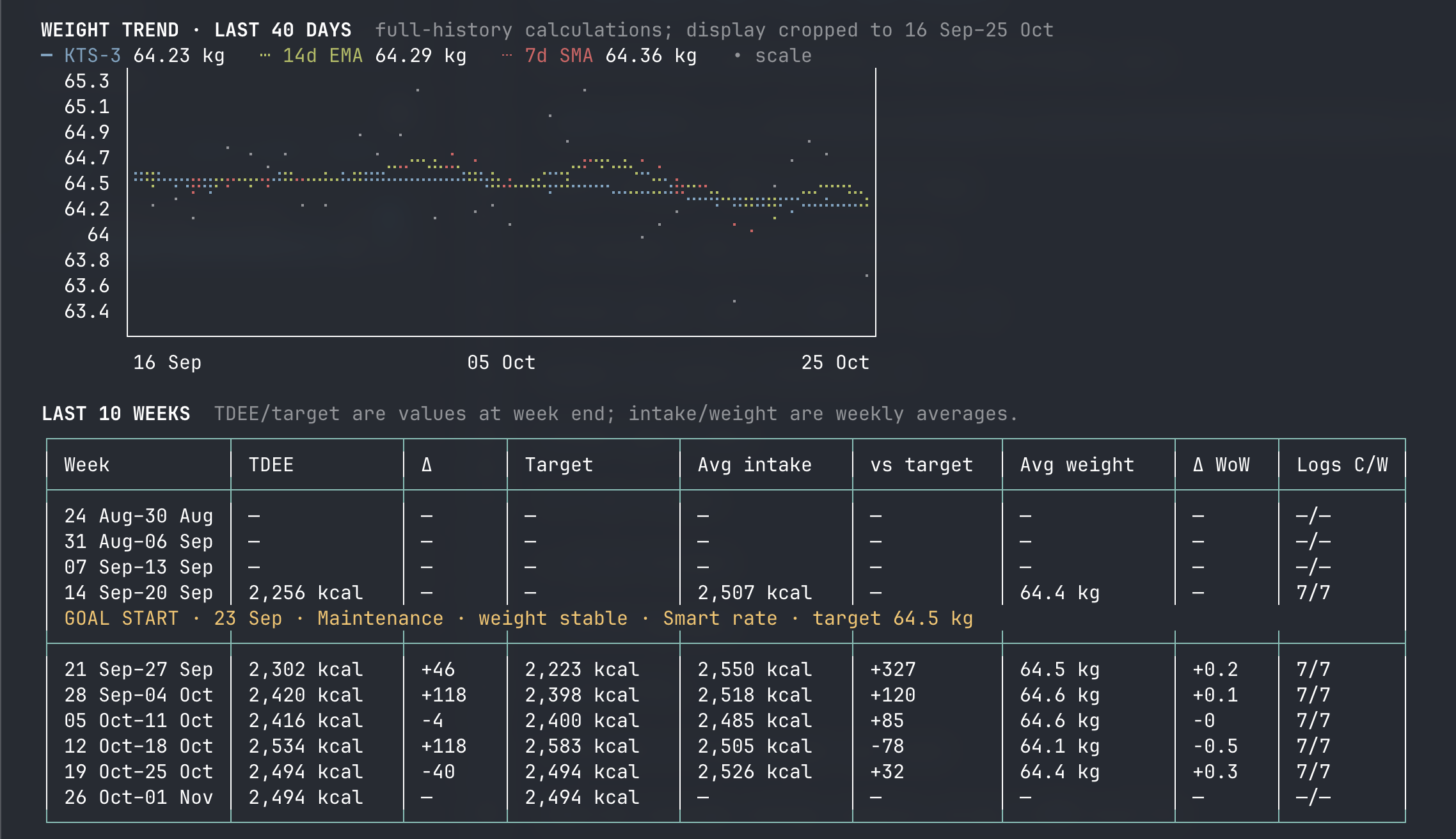
As you can see in this diet log, user roughly maintains their weight when eating around the maintenance calories.
for more details on this method, https://forums.cronometer.com/discussion/7331/tdee-calculators-are-scam-and-do-not-work-dont-bother-with-them-heres-far-more-accurate-method#latest
-
I figured it might be something like that.
I'm not sure what you're getting at with your "BTW" comment. Telling someone you don't know what they "should" do when it comes to their diet—a question they haven't asked!—seems ill-advised at best
-
The difference is roughly 8%. Anyone who considers that significant is splitting hairs and doesn't understand how calorie tracking works in practice.
Packaged foods can have labeling errors of up to 20%, depending on the regulations and jurisdiction. No matter how meticulously you track your food, you cannot expect your recorded calorie intake to be within 10% of your actual intake, even when using Cronometer.
The best approach is to focus on how changes in calorie intake correlate with changes in body weight, rather than obsessing over absolute calorie values. Food labels, portion estimates, and tracking methods all introduce errors, so absolute calorie intake will never be precise enough to rely on in isolation.
What matters for dieting is tracking consistently, monitoring your weight trend, and adjusting your calorie intake based on the results.
-
The 4/4/9 rule is an approximation. Cronometer uses food-specific energy factors when available in databases such as USDA and NCCDB. For example, a food's protein might contribute 4.27 kcal/g rather than exactly 4 kcal/g. These differences can accumulate across ingredients.
Already discussed here: https://forums.cronometer.com/discussion/3619/macros-arent-adding-up-to-calories
Fiber and other energy sources. Total carbohydrate includes fiber, and fiber can contribute energy, although generally less than 4 kcal/g. Depending on the food and the carbohydrate figures being displayed, this can also affect the calculation.
There are multiple other reasons for numbers not adding up; it doesn't always mean there is something wrong with Cronometer.