Secret of achieving very Record High Accuracy with Cronometer like a Super Nerd

I promise, you won't be sold anything. This method is completely free and won't cost you a single cent! I've included the data as proof in the post below, and I'll also show you how to achieve the same results using Cronometer's free plan. It will help you defeat all other nerds out there!
Many people use AI tools like ChatGPT, Claude, and Gemini in ways that don't help them achieve their goals.
Others use Garmin and Apple Watch calorie-burn estimates to adjust their Cronometer data, get poor results, and blame Cronometer.
First, ask yourself: Is your goal perfect calorie tracking, or results from maintenance, bulking, or cutting?
1. Calorie Tracking Has Limitations
Even meticulous tracking cannot measure calories perfectly.
- Natural variation: the apple in my garden has different amount of sugar (hence energy) than the apple you eat still they are the same apple in calorie tracking app.
- Food labels: Permitted labeling tolerances vary by jurisdiction and food type in many cases can be off by upto 20% permissible!
- The 4/4/9 rule: It's an approximation. Cronometer can use food-specific energy factors from databases such as USDA and NCCDB.
- Fiber: It contributes energy differently from digestible carbohydrates.
2. Don't Trust Smartwatches for Precise Calorie Burn
Wearables can track activity trends, but estimating energy expenditure is much harder.
A 2020 systematic review by Fuller et al. found that consumer wearables often perform poorly at estimating energy expenditure, even when they measure steps and heart rate reasonably well. Across brands like Apple, Garmin, Polar, and Withings, calorie burn estimates frequently showed substantial error, often in the 15–40% range and sometimes exceeding 50%. Wearables can still be useful for tracking trends, but not for precise calorie calculations.
Reference: Fuller et al. (2020), The Accuracy of Wearable Physical Activity Monitors in Chronic Disease Prevention and Rehabilitation: A Systematic Review of the Literature. International Journal of Medical Informatics.
Don't treat smartwatch calorie-burn estimates as your actual daily calorie expenditure.
3. Understand TDEE
TDEE (Total Daily Energy Expenditure) is the energy your body burns over 24 hours.
Maintenance calories, maintenance intake, and maintenance energy needs refer to the intake that maintains body weight over time.
A simplified equation:
TDEE = BMR + TEF + EAT + NEAT
- BMR: Basal Metabolic Rate
- TEF: Thermic Effect of Food
- EAT: Exercise Activity Thermogenesis
- NEAT: Non-Exercise Activity Thermogenesis
Deficit = TDEE − Intake
Surplus = Intake − TDEE
If an 80 kg man maintains his weight at 2,700 kcal/day, that intake is his approximate maintenance level.
A very common mistake among beginners is confusing BMR with overall maintenance calories. BMR is actually just one component of your TDEE.
4. Real-World Dieting Examples
Lean bulk
Lean bulking is sensitive to maintenance-estimation errors because the required surplus is often small.
Each row below represents one week.
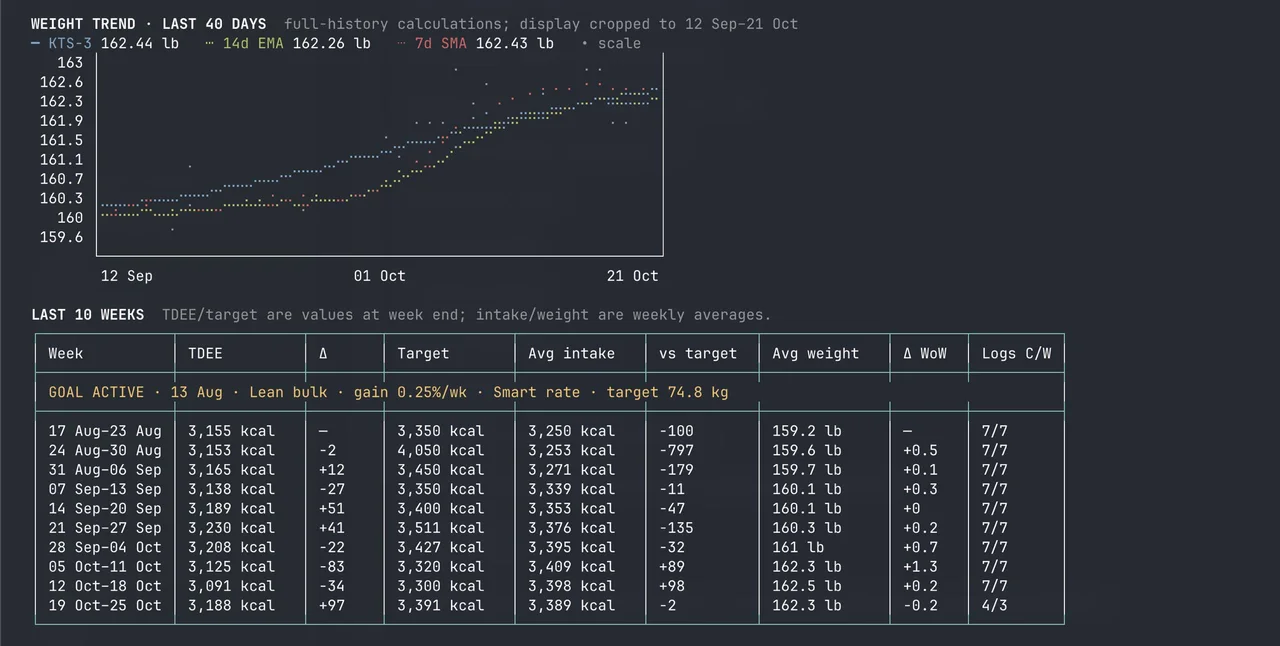
Start: 159.2 lb (17–23 Aug)
End: 162.3 lb (19–25 Oct)
Gain: 3.1 lb over 9 weekly intervals.
Average gain:
3.1 ÷ 9 = 0.34 lb/week, or approximately 0.22% of body weight per week.
Using the rough 3,500 kcal/lb approximation:
0.344 × 3,500 ÷ 7 ≈ 172 kcal/day surplus.
That's roughly equivalent to two extra slices of bread daily, depending on the bread.
Maintenance
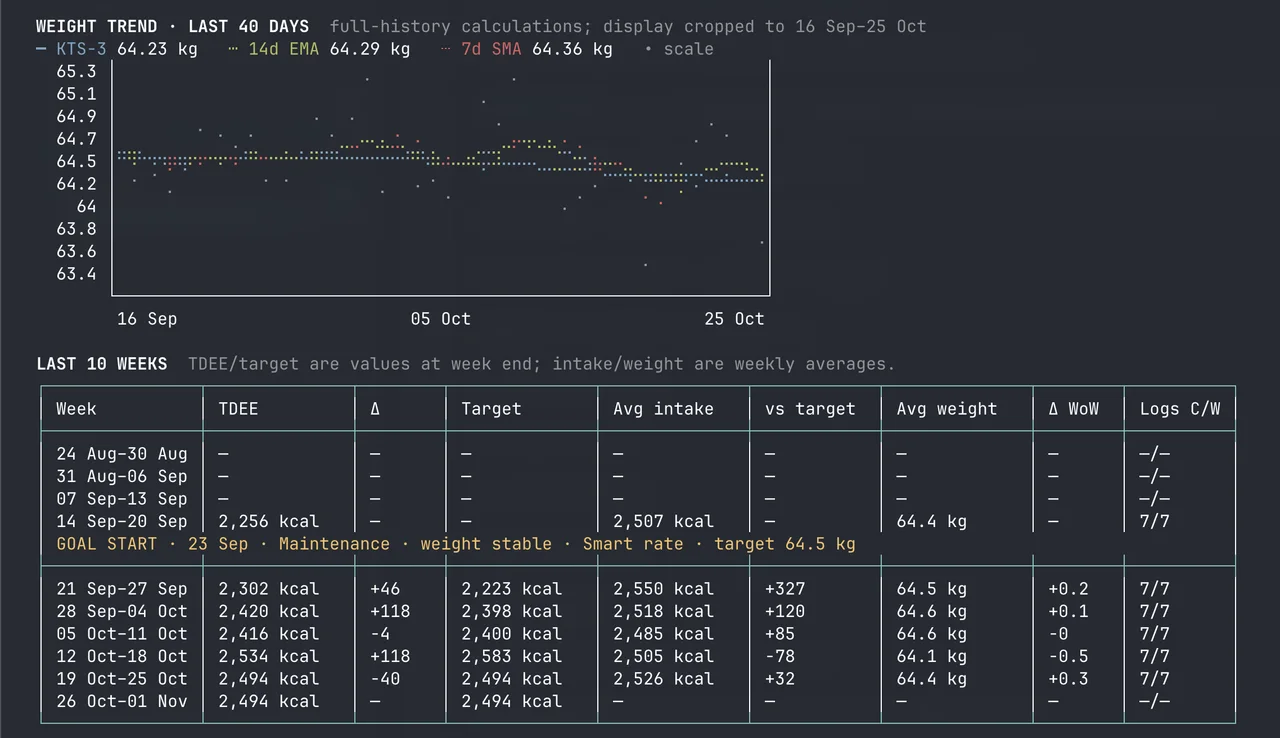
If your weight trend stays stable, your average calorie intake provides a useful estimate of maintenance.
Cutting
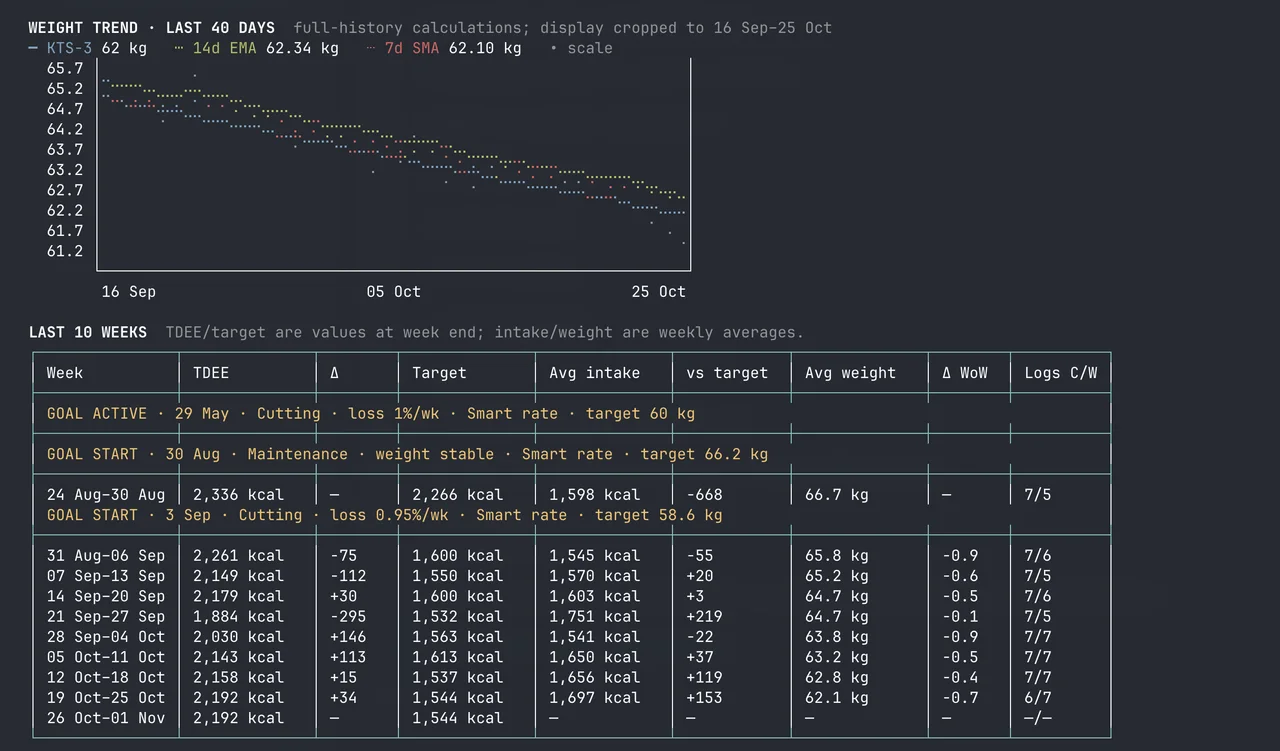
During a cut, compare calorie intake with your weight trend. Losing too quickly may indicate an excessive deficit; losing too slowly may indicate a smaller-than-expected deficit.
Water, glycogen, and sodium affect short-term weight, so use trends over multiple weeks.
5. How to achieve high Accuracy on your Goals like those dieting logs above!
Since calorie tracking isn't "precise" and Energy Expenditure from smart watch is widely inaccurate, what can we do to achieve Super Nerd level of "accuracy" on dieting?
Calorie tracking alone cannot reveal your actual expenditure, and smartwatches cannot reliably solve that problem.
Instead, correlate calorie intake with body-weight trends. This is called adaptive TDEE estimation.
Track your calorie intake in Cronometer and weigh yourself consistently. An adaptive TDEE method uses these two inputs to estimate your actual energy expenditure without relying on smartwatch calorie-burn estimates.
Your maintenance needs can change as your weight, activity, and diet change, so estimates should adapt over time.
You don't need an expensive subscription or a new smartwatch.
Here's the free method:
Comments
-
Great writeup. The one thing I’d add for anyone reading: of the four components, NEAT is the silent killer of accuracy. BMR you can estimate within ~10%, TEF is fairly stable, EAT people overestimate wildly (watches are 15-40% high as you said) — but NEAT can swing 300-800 calories between two people with the same job title. One person paces on calls, another sits still for 9 hours.
That’s why two people with identical stats get different “true” TDEEs, and why the trend-based method you describe is the only way to find yours. Formulas get you in the neighborhood; the scale tells you the address.
-
You don't need to estimate NEAT; instead of finding all the components, a person can directly calculate TDEE from weight and calorie intake data using the adaptive TDEE technique.
TEF can easily be calculated from macro intake.