Is Cronometer only accurate and efficient for USA?


I'm a new subscriber. On one hand, I'm very impressed and happy with this app. I feel it may be invaluable, and could change my life. On the other hand, I'm very disappointed to find it is not ideal for UK users.
Firstly, many of the items I scan into Cronometer are instantly recognised, but when I look closely, they only contain the basic info on the label, such as protein, fat, salt etc and contain no information on nutrients and vitamins. Eg. I just scanned a Marks & Spencer minced beef and onion pie, and there are no nutrients or vitamins in it. I know for a fact that minced beef contains iron, to say the least.
I also scanned in Tesco mixed peanuts, almonds and cashew nuts. Cronometer instantly recognised it so I added it to my favourites. But then I noticed again - no nutrient or vitamin information. So I had to create my own food and added in the 3 nuts separately. Then I found they contain a super-food level of minerals nutrients and vitamins - all of which would not have been logged if I hadn't noticed.
I also find that when a food isn't recognised, and you add it yourself with photos of the front and nutrition label, the same applies. No vitamins, or minerals listed - only the basic protein, fat, salt etc.
I'm not sure why these foods are recognised but only basic information is catalogued, not why this isn't pointed out to users? It is very possible for people to be logging their every food and drink trying to ensure they get all the recommended daily vitamins and minerals not realising that many of their foods are not showing any nutrient or vitamin information.
Comments
-
https://support.cronometer.com/hc/en-us/articles/360018239472-Data-Sources
The program uses a variety of data sources with the US based data most complete. It has only chosen a select number of data points from the English reference noted in the link however if you follow through to that source website it appears that they CoFID do not track all brand names but use only a smattering of same.
Often Crono will have a generic suggestion. In reference to the consumer based info (CRDB), yes the product brand may only have a limited number of nutrients (say 15) versus the generic (50 or more) equivalent.
International users always asking for greater inclusion which is fair. We are left to judge Crono against similar products. Maybe it could be another differential between free and paid users. -
You're are better off creating a recipe from generic ingredients.
Scanning the barcode is very limited. https://cronometer.com/blog/accurate-data-tips/I looked at Tesco's mixed nuts they only give a percentage of nuts and the high level nutrition label. https://www.tesco.ie/groceries/en-IE/products/301916666?srsltid=AfmBOooGA7Vs8Uou1m-64HsbHBS2kMcrtt8paAXTtFo8JRdp4rySlMWG
INGREDIENTS: Red Skin Peanuts (35%), Blanched Peanuts (35%), Almonds (15%), Cashew Nuts (15%).
The only way to get your detailed micronutrient breakdown whould be to create a recipe with the proportions listed for the nuts using only generic ingredients listed in the NCCDB database.
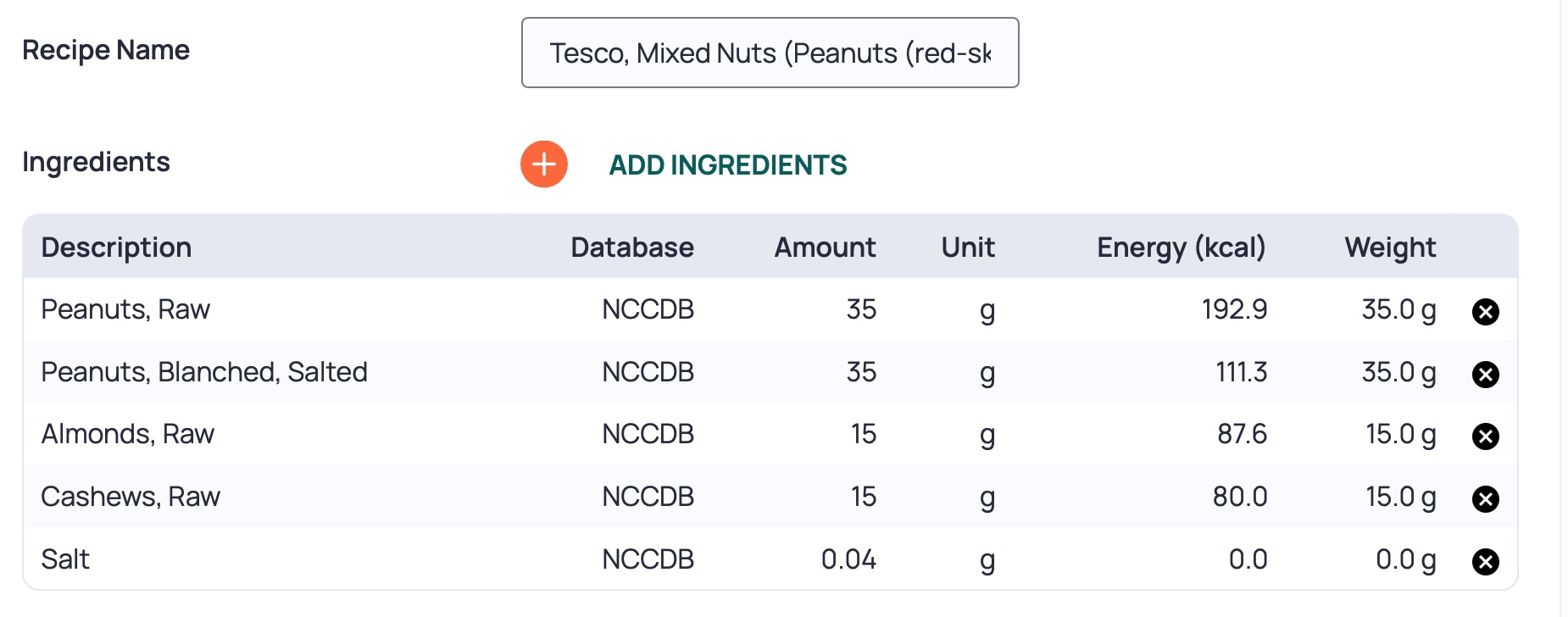
It's worth it if you eat that products alot. Add it to your Favourites.
-
Thanks for your replies. I have realised that the scanner, and the "create custom food" using the scanner are only of use (in UK) if you are only counting calories. They basically just add the ingredients on the label. It is still useful if you are only calorie counting, but useless if trying to monitor your vitamin and mineral consumption, which is what I am trying to do.
The annoying thing is that the app did not tell me that scanning the foods was not adding nutritional information. So I've been happily scanning the foods, unaware that many of them didn't have mineral or vitamin information. This could of course lead to overconsumption of some of them.
I've realised you can create custom recipes, but it means that in the UK at least, if you want to track your vitamins and minerals you need to put a fair amount of work into it.
The other issue is that all the recommended daily consumptions are USA based. I've looked into it, and the UK government recommended daily consumption of minerals and vitamins can vary significantly. Who knows which is right, but some of the US recommendations are double or even quadruple that of the UK. Again, you can edit these values, which is great, but more work.
Overall, the app is very useful and as I suspected, I have found there are several important vitamins and minerals that were almost totally absent from my normal daily diet. Virtually no vitamin C, E, A for example.
-
Interesting points. I did a Google search comparing Canada, USA, UK, German, and the EU and they vary widely. I can see why users would want more sources and data in the app and perhaps to select sources for RDIs for defaults.
Maybe you need to add liver, herring and caviar to your carnivore meal plan. Or do you just supplement?
-
With the help of Cronmeter I have improved my diet, and now make sure I have 3 pieces of fruit and 3 or more vegetables plus mixed nuts each day.